

Surgical Instrument Tracking System Market Forecast 2033 at 5.3% CAGR | Persistence Market Research
surgical instrument tracking system market
Global surgical instrument tracking system market driven by patient safety, compliance, and digital healthcare adoption trends worldwide.
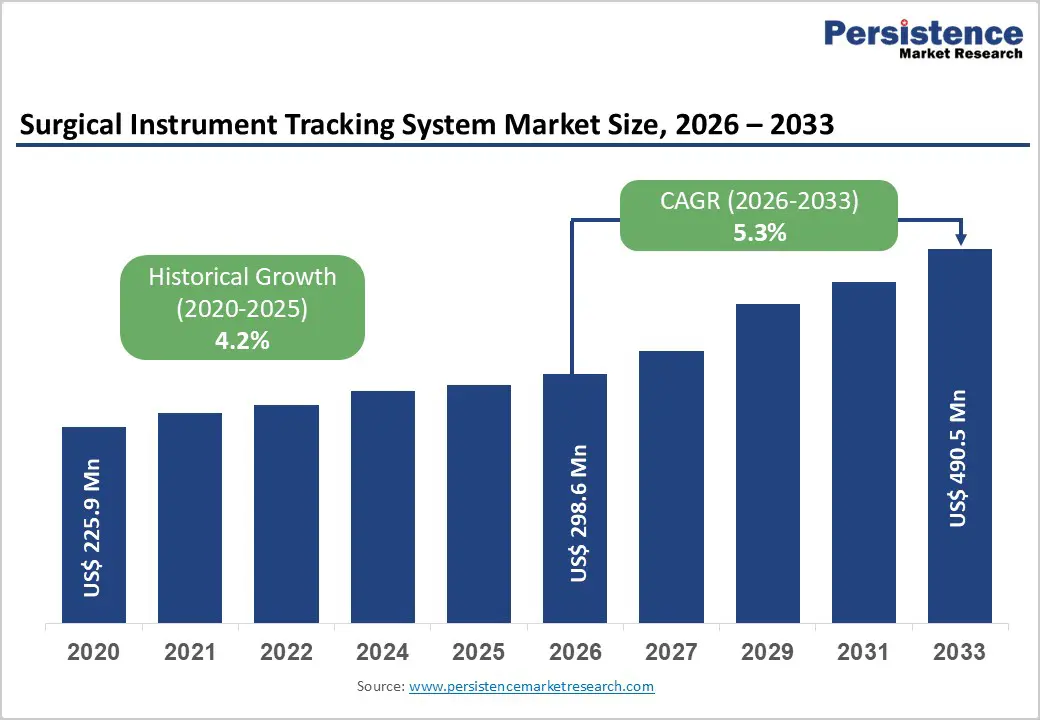
LONDON, UNITED KINGDOM, March 25, 2026 /EINPresswire.com/ -- The global surgical instrument tracking system market is projected to expand significantly, growing from US$ 298.6 million in 2026 to US$ 490.5 million by 2033. This reflects a compound annual growth rate (CAGR) of 5.3% during the forecast period. The steady growth trajectory is driven by increasing surgical volumes worldwide, rising complexity in instrument management, and a strong focus on patient safety and operational efficiency across healthcare facilities.
Healthcare providers are increasingly adopting tracking systems to manage large inventories of reusable surgical instruments. These systems ensure accurate tracking throughout the instrument lifecycle, including usage, sterilization, storage, and maintenance. As surgical procedures continue to rise due to aging populations and chronic disease prevalence, the need for efficient instrument tracking becomes more critical.
Download Your Free Sample & Explore Key Insights: https://www.persistencemarketresearch.com/samples/33305
Market Drivers and Key Trends
One of the primary drivers of market growth is the rising number of surgical procedures globally. Hospitals and ambulatory surgical centers face mounting challenges in managing extensive instrument inventories, which increases the risk of lost or misplaced tools, surgical delays, and retained surgical items. Tracking systems provide real-time visibility and standardized workflows, helping reduce such risks and improve overall efficiency.
Regulatory requirements also play a significant role in driving adoption. Governments and healthcare authorities are enforcing strict guidelines related to traceability, sterilization, and patient safety. Compliance with standards such as Unique Device Identification (UDI) necessitates accurate documentation, which manual systems often fail to provide. As a result, digital tracking solutions are becoming essential.
Technological advancements further accelerate market growth. Innovations such as cloud-based platforms, real-time analytics, and integration with hospital information systems enhance system capabilities. Additionally, the adoption of RFID technology is increasing, enabling automation and improving tracking accuracy compared to traditional methods.
Market Restraints and Challenges
Despite strong growth potential, the market faces certain challenges. High initial implementation costs remain a major barrier, particularly for small and mid-sized healthcare facilities. Expenses associated with software, hardware, tagging, and staff training can be substantial, limiting adoption in cost-sensitive regions.
Workflow disruption during system implementation is another concern. Integrating tracking systems into existing hospital processes often requires redesigning workflows and retraining staff, which can temporarily affect productivity. Resistance to change among healthcare personnel may also slow adoption.
Technical integration challenges further complicate deployment. Compatibility issues with legacy systems and electronic health records can increase complexity and cost. Additionally, concerns related to data accuracy, tag durability, and cybersecurity risks may hinder widespread adoption.
Get Custom Insights Designed for Your Businecss: https://www.persistencemarketresearch.com/request-customization/33305
Opportunities and Emerging Potential
The market presents significant opportunities, particularly in emerging economies. Rapid healthcare infrastructure development in regions such as Asia Pacific, Latin America, and the Middle East is driving demand for advanced tracking solutions. Increasing investments in hospital modernization and digital healthcare systems are expected to boost market penetration.
The expansion of ambulatory surgical centers also creates new growth avenues. These facilities require efficient and scalable solutions to manage high procedure volumes with limited resources. Cloud-based and subscription models are gaining popularity in such settings due to their flexibility and cost-effectiveness.
Furthermore, the integration of advanced technologies such as artificial intelligence and predictive analytics is opening new possibilities. These innovations enable proactive instrument management, reduce downtime, and enhance asset utilization. Growing emphasis on sustainability and cost optimization is also encouraging healthcare providers to adopt tracking systems that extend instrument life cycles and reduce waste.
Segment Analysis
By component, software dominates the market due to its central role in data management, workflow optimization, and regulatory compliance. Software solutions provide real-time insights and improve decision-making, making them indispensable for modern healthcare facilities.
In terms of technology, barcode systems lead the market owing to their cost efficiency and ease of implementation. However, RFID technology is emerging as the fastest-growing segment due to its ability to enable automation and real-time tracking.
By end user, hospitals account for the largest market share. This is attributed to their high surgical volumes, complex operations, and stringent regulatory requirements. Ambulatory surgical centers are also witnessing increased adoption, contributing to overall market growth.
Regional Insights
North America holds the largest market share, supported by advanced healthcare infrastructure, high adoption of digital technologies, and strict regulatory frameworks. Europe follows with steady growth driven by strong compliance standards and increasing surgical demand.
Asia Pacific is the fastest-growing region, fueled by rapid healthcare development, rising awareness of patient safety, and expanding surgical capacity. Increasing investments in hospital infrastructure and digital solutions are expected to drive significant growth in this region.
Competitive Landscape
The market is highly competitive, with key players focusing on innovation, system integration, and regulatory compliance. Companies are investing in advanced technologies and strategic partnerships to strengthen their market position and meet evolving healthcare demands.
Overall, the surgical instrument tracking system market is poised for steady growth, driven by technological advancements, regulatory requirements, and the increasing need for efficient and safe surgical operations worldwide.
Checkout Now & Download Complete Market Report: https://www.persistencemarketresearch.com/checkout/33305
Global Surgical Instrument Tracking System Market Segmentation
By Component
Software
Hardware
Services
By Technology
Barcode
Radio Frequency Identification (RFID)
By End User
Hospitals
Ambulatory Surgery Centers
Others
By Region
North America
Europe
East Asia
South Asia and Oceania
Latin America
Middle East and Africa
Read Related Reports:
Polymerase Chain Reaction Market
Protein Purification Reagents Market
Persistence Market Research
Persistence Market Research Pvt Ltd
+1 646-878-6329
email us here
Visit us on social media:
LinkedIn
Instagram
Facebook
YouTube
X
Legal Disclaimer:
EIN Presswire provides this news content "as is" without warranty of any kind. We do not accept any responsibility or liability for the accuracy, content, images, videos, licenses, completeness, legality, or reliability of the information contained in this article. If you have any complaints or copyright issues related to this article, kindly contact the author above.
