

Informing on science news in the world
Provided by AGP
A molecular twist boosts solar-powered hydrogen peroxide production
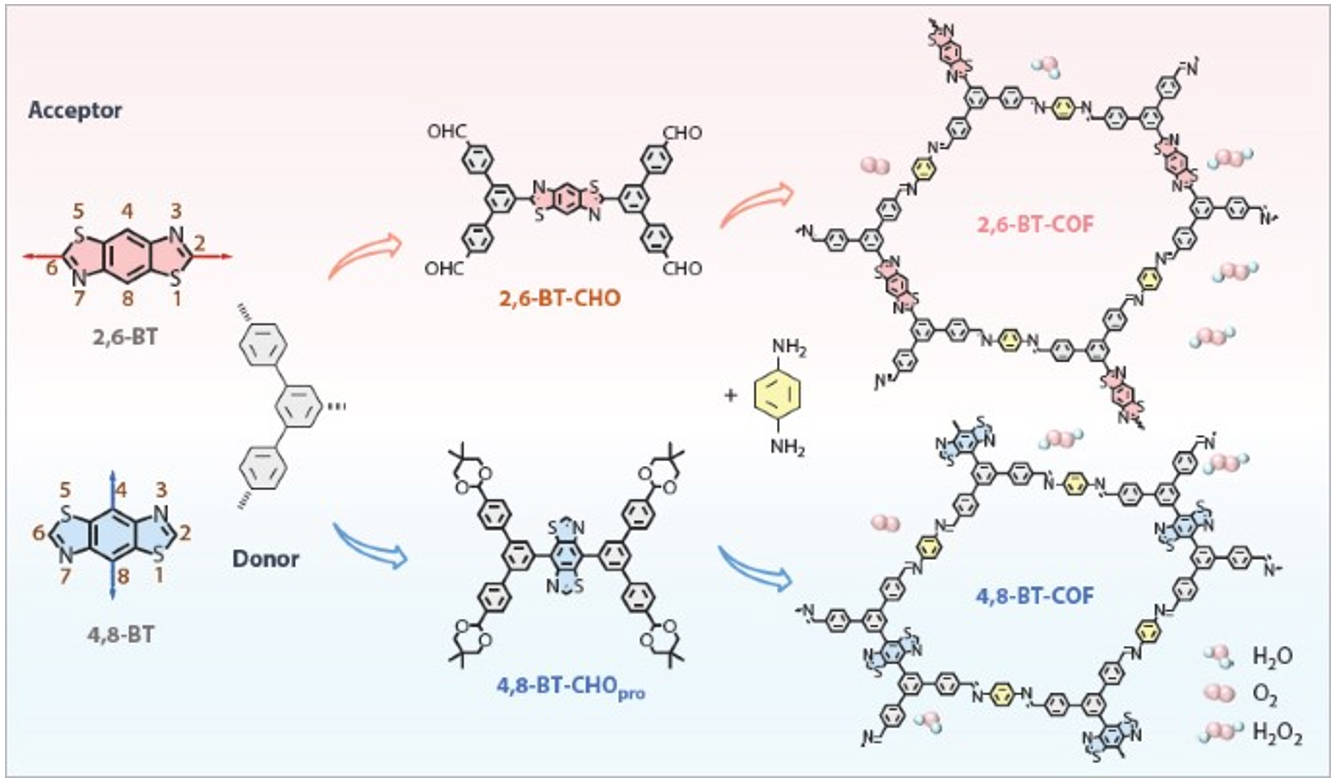
Regioisomeric design of benzobisthiazole-based COFs.
GA, UNITED STATES, May 11, 2026 /EINPresswire.com/ -- Scientists have developed two new covalent organic frameworks (COFs) that efficiently produce hydrogen peroxide — a valuable chemical and potential solar fuel — using only water, oxygen, and visible light. By carefully tuning the molecular connectivity of an electron-deficient building block called benzobisthiazole (BT), the team created two regioisomeric COFs with distinctly different photocatalytic activities. The better-performing framework achieved a hydrogen peroxide production rate of 1638 μmol·g⁻¹·h⁻¹ in pure water under visible light, outperforming its structural isomer by about 57%. This work demonstrates that precise control over molecular topology can dramatically boost photocatalytic efficiency.
Hydrogen peroxide is widely used in bleaching, wastewater treatment, and chemical synthesis, and it also holds promise as a clean energy carrier. However, its current industrial production relies on the energy-intensive anthraquinone process, which generates significant waste. Photocatalysis offers a greener alternative, but most organic photocatalysts suffer from low crystallinity, poor charge separation, and limited structural tunability. Covalent organic frameworks (COFs) — porous, crystalline polymers with designable architectures — have emerged as promising candidates, yet precisely controlling their electronic properties to enhance catalytic activity remains a challenge. Based on these issues, an in-depth investigation into how molecular connectivity affects charge dynamics and photocatalytic performance is urgently needed.
Researchers from Jilin University in China report (DOI: 10.1007/s10118-025-3551-z) in the Chinese Journal of Polymer Science two new regioisomeric donor-acceptor COFs based on benzobisthiazole (BT). By exploiting BT's two orthogonal conjugation pathways — 2,6- versus 4,8-substitution — the team constructed highly crystalline frameworks with distinct topological connectivities. The 2,6-BT-COF showed markedly superior photocatalytic hydrogen peroxide production under visible light, highlighting how subtle changes in molecular wiring can dramatically alter performance.
The key innovation lies in molecular regioisomerism — altering only the substitution pattern on the BT unit while keeping the overall chemical composition unchanged. The team synthesized two aldehyde-functionalized BT monomers and polymerized them with 1,4-phenylenediamine via Schiff-base condensation. Both COFs showed high surface areas (up to 1056 m²·g⁻¹), excellent crystallinity with AA-stacking, and strong visible-light absorption. However, 2,6-BT-COF exhibited a narrower optical band gap (2.21 eV versus 2.45 eV) and a more negative conduction band edge, thermodynamically favoring oxygen reduction. Photophysical studies revealed that 2,6-BT-COF achieves superior charge separation: higher photocurrent density, lower charge-transfer resistance, and a longer carrier lifetime (1.21 ns versus 0.91 ns). Electron paramagnetic resonance (EPR) spectroscopy and trapping experiments confirmed that both COFs produce hydrogen peroxide via a two-step single-electron oxygen reduction reaction (ORR) pathway, with superoxide (O₂⁻) as the key intermediate. The 2,6-BT-COF reached an apparent quantum yield (AQY) of 3.86% at 420 nm — nearly three times that of its isomer. Both materials remained stable over five consecutive cycles and under harsh conditions, including boiling water and hydrogen peroxide solutions.
“We were surprised to see how dramatically a simple change in molecular connectivity affected the photocatalytic performance,” the authors said. “The 2,6-substitution pattern creates a more favorable electronic pathway that helps separate charges and prevent them from recombining. It’s like rearranging the same set of wires into a more efficient circuit. This tells us that molecular topology isn’t just a structural detail — it's a powerful lever for designing better photocatalysts. We believe this isomerization strategy can be broadly applied to other COF systems for solar fuel production and environmental remediation.”
This work opens a practical route toward decentralized, solar-driven hydrogen peroxide production. Unlike the energy-intensive anthraquinone process, these COF photocatalysts operate in pure water under visible light without sacrificial agents, though adding benzyl alcohol further boosts output. The materials' excellent stability in water, hydrogen peroxide solutions, and light makes them suitable for repeated use. Beyond disinfection and bleaching, on-site hydrogen peroxide generation could benefit remote areas or emergency settings where infrastructure is limited. More broadly, the molecular isomerization strategy demonstrated here provides a clear design principle for optimizing charge dynamics in organic semiconductors — not only for hydrogen peroxide photosynthesis but also for other solar-driven transformations such as water splitting, carbon dioxide reduction, and organic synthesis.
DOI
10.1007/s10118-025-3551-z
Original Source URL
https://doi.org/10.1007/s10118-025-3551-z
Funding information
This work was financially supported by the National Natural Science Foundation of China (No. 52473211) and the Science and Technology Development Plan Project of Changchun, China (No. 2024GZZ03).
Lucy Wang
BioDesign Research
email us here
Legal Disclaimer:
EIN Presswire provides this news content "as is" without warranty of any kind. We do not accept any responsibility or liability for the accuracy, content, images, videos, licenses, completeness, legality, or reliability of the information contained in this article. If you have any complaints or copyright issues related to this article, kindly contact the author above.
