

Darkness Matters: Zitong Hui’s Ongoing Research and Visualization on Urban Darkness in Central Park, New York
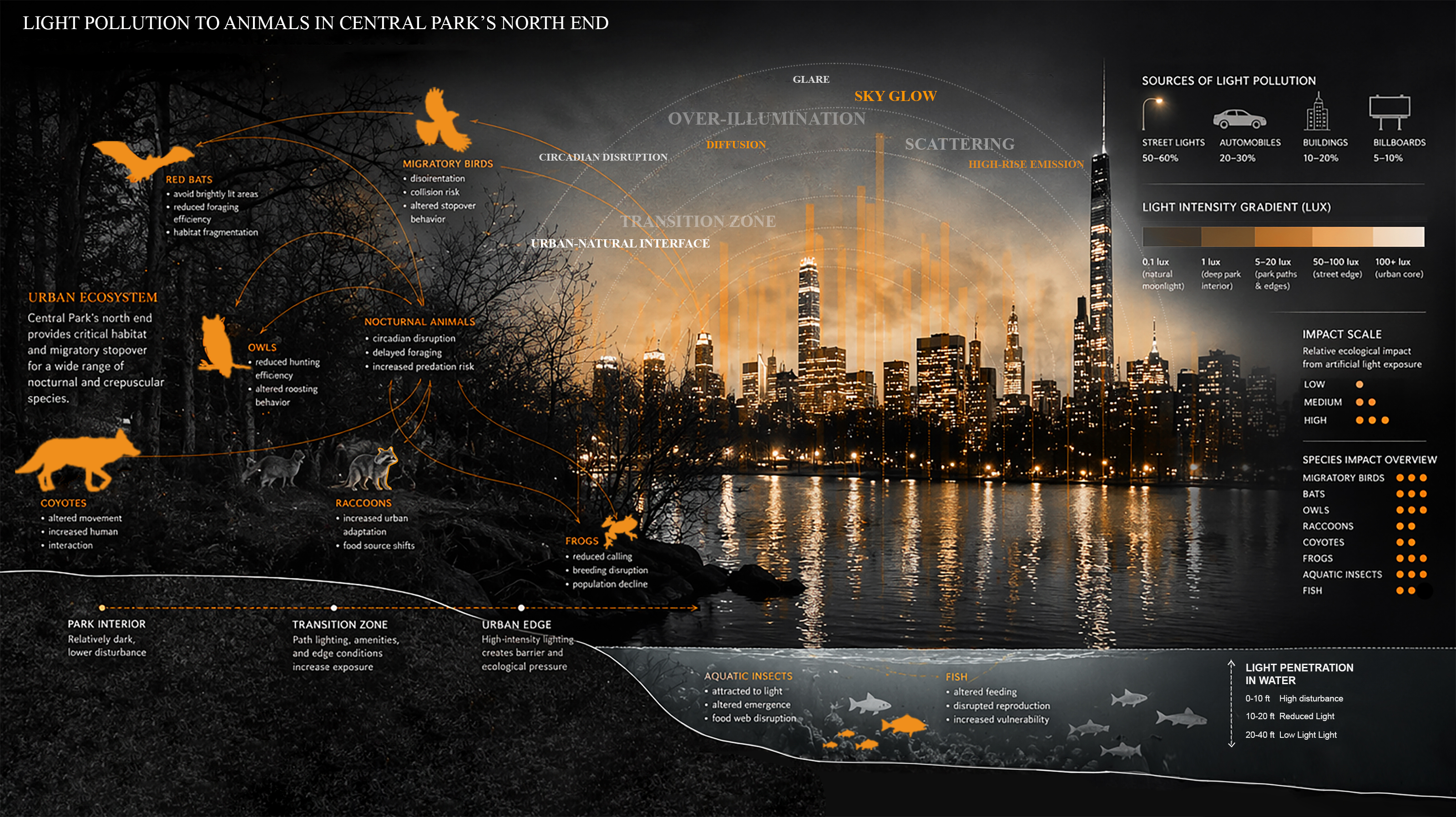
Ecological impacts of artificial light pollution on wildlife at the northern edge of Central Park, illustrating how urban illumination influences migratory birds, bats, nocturnal mammals, aquatic species, and habitat connectivity across the urban–natural interface.
Exploring the intersection of artificial light, ecological conditions, and spatial experience in Central Park, New York
NEW YORK CITY, NY, UNITED STATES, August 1, 2026 /EINPresswire.com/ -- Artificial light has become inseparable from contemporary urban life. It supports transportation, public safety, commerce, recreation, and the twenty-four-hour rhythm of cities. Yet as urban environments become increasingly illuminated, darkness itself is gradually disappearing from the experience of the city.Landscape designer Zitong Hui (Shirley) began exploring this condition through “Darkness Matters”, her graduate thesis project at the Rhode Island School of Design. Since its initial development, Shirley has continued expanding the project as an ongoing design research initiative examining urban darkness, artificial light, ecological conditions, and nighttime spatial experience in Central Park, New York.
Rather than approaching light pollution primarily as a scientific problem, “Darkness Matters” investigates how darkness can be observed, visualized, experienced, and ultimately reconsidered through the lens of landscape architecture.
Central Park provides a particularly compelling setting for this exploration. Surrounded by one of the world’s most intensely illuminated urban environments, the park creates a striking contrast between the brightness of Manhattan and the relative darkness of landscape. Along its edges, illuminated buildings and streets remain highly visible, while deeper within the park, vegetation, topography, water, and distance gradually interrupt the surrounding urban glow.
For Shirley, this transition reveals that darkness is not simply the absence of light. It is a spatial condition that changes in intensity, visibility, enclosure, and atmosphere.
A central component of Darkness Matters is therefore the visualization of urban darkness. Through mapping, photography, spatial observation, digital modeling, environmental data, and visual analysis, Shirley explores how artificial light interacts with different landscape conditions across Central Park.
Pathways, tree canopies, open lawns, water bodies, changes in elevation, and views toward the surrounding skyline all influence how nighttime environments are perceived. By translating these conditions into drawings, maps, diagrams, and spatial sequences, the project makes an often-overlooked dimension of the city more visible.
The research understands darkness as a gradient rather than a binary condition. Moving from Manhattan into Central Park can become a sequence of experiences—from brightly illuminated streets and park entrances to partially shaded paths and increasingly enclosed landscapes where the surrounding city gradually disappears from view.
Ecology also informs this investigation. Central Park functions as an important urban habitat for birds, insects, bats, small mammals, and other species. Artificial illumination can alter nighttime environmental conditions within these habitats. Rather than positioning the project as ecological science, Shirley uses this relationship as an additional lens through which to reconsider how urban landscapes might balance human activity with the presence of other species after dark.
This leads to a larger design question: How can landscape architecture actively shape the experience of darkness?
Darkness Matters explores several spatial strategies. Topography, including berms, depressions, and elevation changes, can block or redirect surrounding light. Layered vegetation and tree canopies can create varying degrees of enclosure, while visual framing can selectively reveal or conceal illuminated buildings, landscapes, and the night sky.
Lighting itself becomes another design material. Changes in brightness, color temperature, direction, spacing, and duration can produce different nighttime atmospheres without uniformly illuminating the landscape. In this approach, light and darkness are not opposites, but complementary elements that can be carefully choreographed.
Shirley’s continuing work positions visualization as more than a method of representing research. It becomes part of the design process itself—connecting environmental information with spatial perception and translating complex urban conditions into experiences that can be intuitively understood.
Ultimately, Darkness Matters proposes that darkness should not be treated as leftover space between illuminated areas. Like vegetation, water, topography, and light, darkness can be shaped, framed, protected, and experienced.
Through her ongoing investigation of Central Park, Shirley is exploring how landscape architecture can make urban darkness visible again—and how the relationship between light, ecology, landscape, and human perception might contribute to a more thoughtful experience of cities after sunset.
Zitong Hui “Shirley”
Landscape Designer
shirley2357@gmail.com
Visit us on social media:
Instagram
Legal Disclaimer:
EIN Presswire provides this news content "as is" without warranty of any kind. We do not accept any responsibility or liability for the accuracy, content, images, videos, licenses, completeness, legality, or reliability of the information contained in this article. If you have any complaints or copyright issues related to this article, kindly contact the author above.
