

Compostable Packaging Market
Compostability is becoming a regulatory requirement but infrastructure is becoming the competitive constraint. That disconnect is reshaping where the industry’s next $15B of value will go.
Wilmington, DE, United States, Sept. 09, 2026 (GLOBE NEWSWIRE) -- Brands Delaying Compostable Packaging Adoption may soon Face Structural Compliance and Supply Risks
For most of the past decade, compostable materials sat at the edge of packaging strategy, treated as a pilot line or a marketing gesture rather than a procurement decision. That positioning no longer holds. Regulation, retailer mandates, and brand commitments have converged, and the compostable packaging market is now a contested arena where feedstock access and certified capacity, not intent, separate the prepared from the exposed.
The companies moving fastest are not the loudest. They are the ones quietly locking in resin supply, securing converter relationships, and standardizing certified formats while competitors still debate timelines. What looks externally like a fragmented, early-stage category is, structurally, a market where early positioning is compounding into durable advantage, and the gap between those two postures is widening every quarter.
Request a Free Sample Report: https://marketmindsadvisory.com/request-sample/?report_id=8
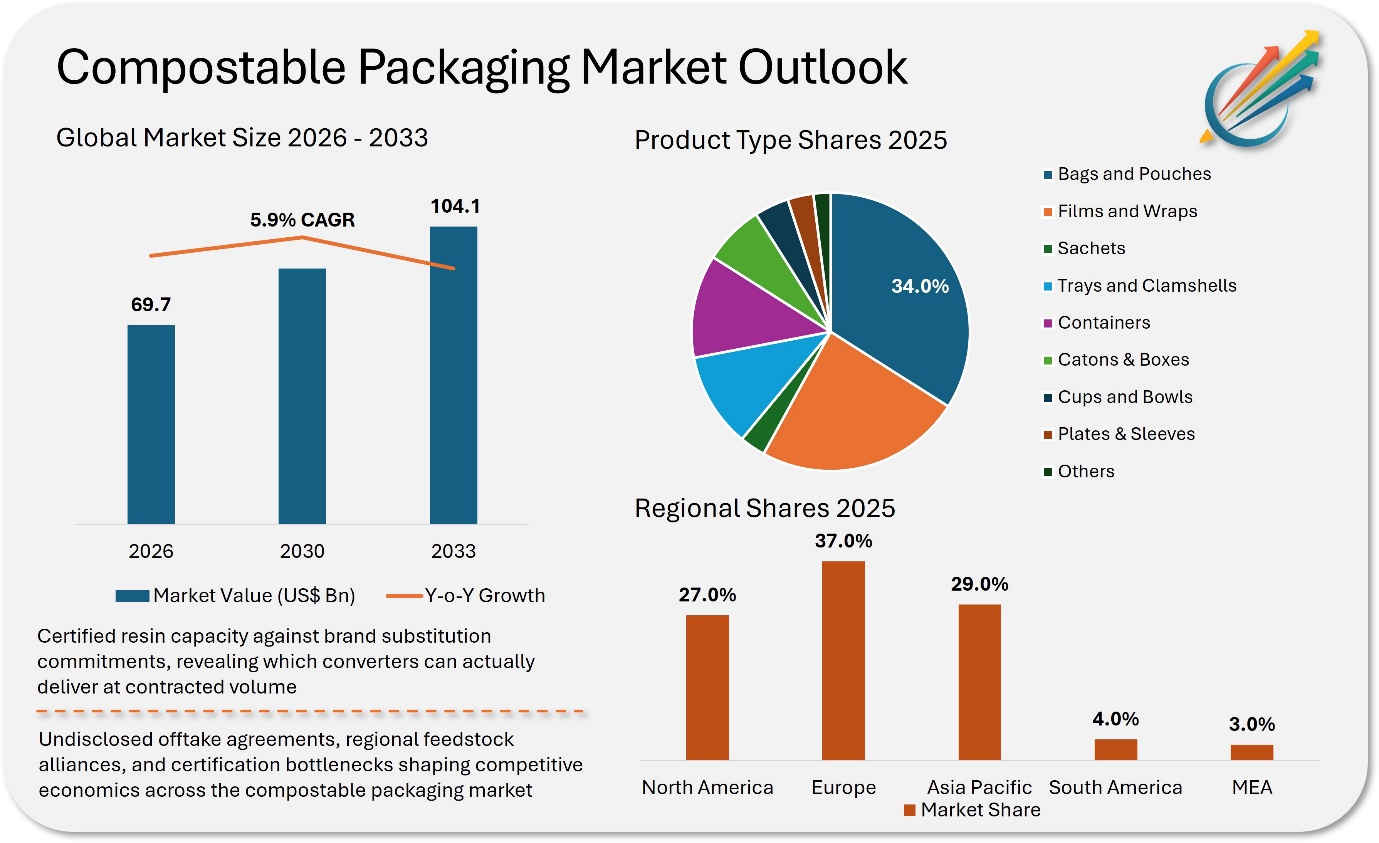
Key Takeaways from Compostable Packaging Market
- The compostable packaging market is valued at US$ 69.7 billion in 2026, reflecting mainstream procurement adoption and is projected to reach US$ 104.1 billion by 2033 as substitution accelerates across food and retail.
- PLA remains the commercial workhorse, while PHA captures premium home-compostable and marine-degradable demand in compostable packaging market.
- Food packaging anchors demand, driven by the difficulty of recycling food-soiled conventional plastics.
- Molded fiber from bagasse is scaling fastest in rigid foodservice, balancing strength and supply stability all over compostable packaging market.
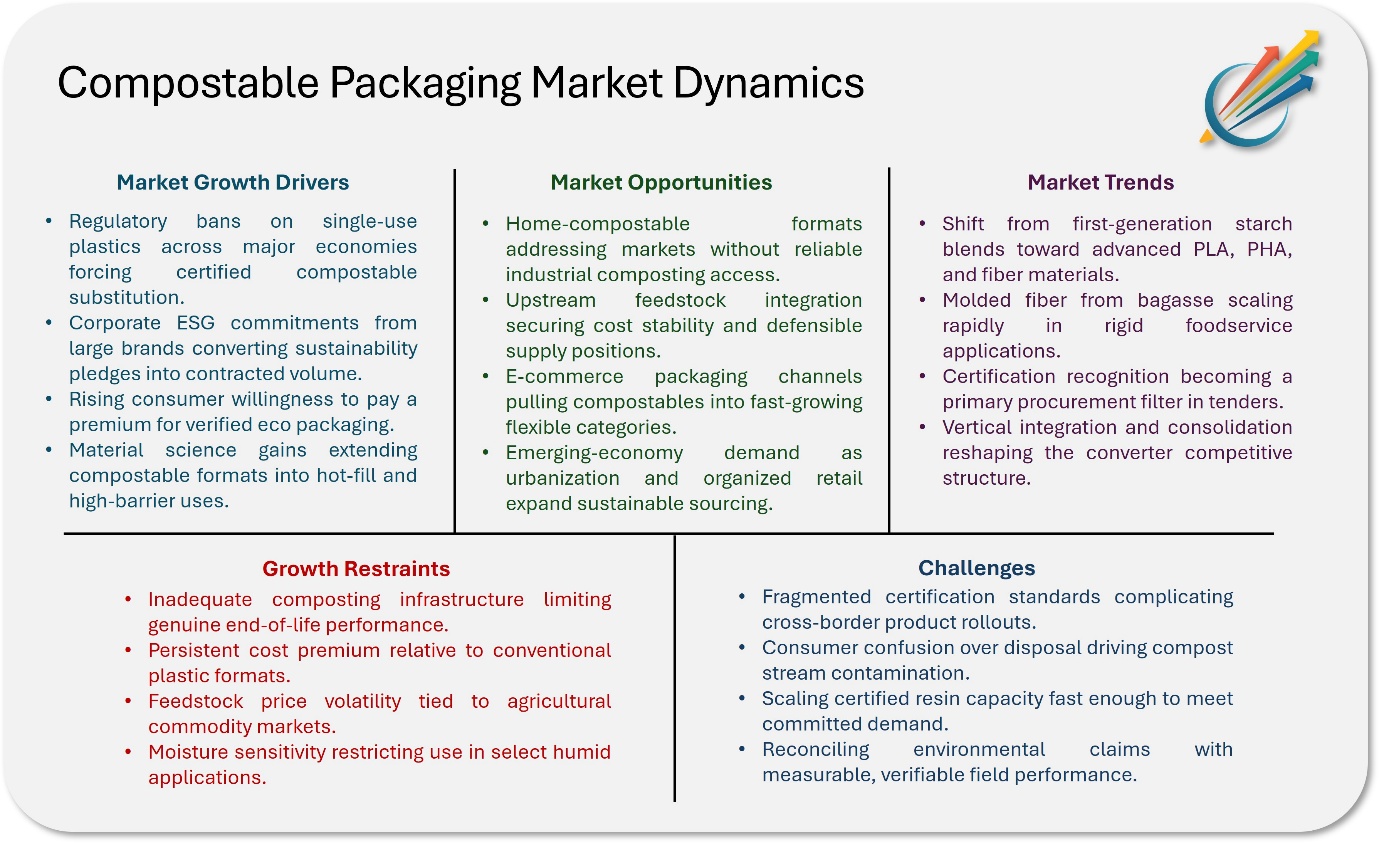
- Industrial composting infrastructure gaps remain the binding constraint on end-of-life performance claims.
As per Senior Analyst from Market Minds Advisory, "The decisive contest in compostable packaging market is no longer about whether compostable formats scale, but about who controls certified resin and converter capacity when demand tightens. Companies that secure those positions over the next four to six quarters will set the cost economics that everyone else negotiates against."
Early Movers Quietly Locking Certified Resin and Converter Capacity ahead of Competitors
The conditions that made early movement optional have closed. Regulation has shifted from signaling to enforcement, and procurement teams are now responding to binding deadlines rather than aspirational targets.
- Regulation has become a hard constraint: The EU Single-Use Plastics Directive and successive Packaging and Packaging Waste rules have removed conventional formats from key categories, forcing foodservice and retail buyers toward certified compostable alternatives on fixed timelines.
- Certified capacity is finite: Resin output and converter lines carrying recognized compost certifications cannot scale on demand, and buyers who delay are discovering that qualified supply is being committed ahead of them.
-
Brand commitments have created a demand floor: Major quick-service and consumer goods brands have published plastic-elimination targets, converting voluntary ambition into predictable, contractable volume that rewards suppliers already in position.
Economics of Compostable Packaging Shifting Towards Resin and Feedstock Ownership
Value in the compostable packaging market is migrating upstream, away from finished conversion and toward feedstock control and certified material science. The companies capturing margin are those treating resin supply as a strategic asset rather than a procurement step.
- Vertical integration into feedstock: Converters are moving into PLA, bagasse, and agricultural-waste sourcing to secure cost and availability, building technical barriers that pure converters cannot easily replicate.
- Certification as a competitive moat: TÜV Austria OK Compost, EN 13432, and ASTM D6400 recognition have become procurement filters, and material developers holding broad certified portfolios are structurally advantaged in tenders.
-
Performance-engineered blends: High-heat CPLA grades and PLA-PHA hybrids are unlocking hot-fill and rigid applications once closed to compostables, shifting the contest from basic substitution toward proprietary formulation.
Assumptions around Compostable Packaging adoption are already Starting to Break Down
A meaningful share of headline substitution commitments will slip past their stated deadlines. Brand pledges significantly exceed currently certified resin capacity and reliable composting infrastructure. Identifying which commitments are genuinely supply-backed is now the more useful strategic question than tracking pledge volume.
Home-compostable formats, not industrial-compostable ones, will define the premium tier. With municipal composting access still uneven, materials that degrade outside controlled facilities resolve the end-of-life credibility problem, and buyers in advanced markets are already paying for that certainty.
Consolidation will accelerate faster than the fragmented competitor count suggests in the compostable packaging market. Chemical and paper conglomerates with capital and feedstock reach are positioned to absorb specialized innovators, and the window for independent scaling is measurably narrowing.
New Competitive Structure Forming across the Compostable Packaging Market Ecosystem
Regulatory Enforcement Replacing Voluntary Adoption
Plastic restrictions across the EU, Canada, India, and several US states have moved from announced intent to active enforcement, removing conventional formats from defined categories. This converts compostable packaging from a sustainability choice into a compliance requirement, and procurement teams are now sourcing against legal deadlines. The effect is a demand base that holds regardless of consumer sentiment cycles, giving suppliers with certified inventory a structurally protected position.
Feedstock Economics and Supply Security
Corn starch for PLA and sugarcane bagasse for molded fiber tie material cost directly to agricultural markets, introducing volatility that conventional resin buyers rarely faced. Manufacturers are responding by integrating upstream and signing multi-year feedstock agreements. In the assessment of this research, supply security has become the binding constraint, and firms that treat feedstock as a strategic asset will hold a durable cost advantage over those exposed to spot pricing.
Material Science Closing the Performance Gap
Earlier compostable formats failed in hot-fill, humid, and high-barrier applications, limiting them to cold and dry use. Stereocomplex PLA blends now exceed 140 degrees Celsius heat resistance, and PHA delivers marine biodegradability that broadens addressable demand. These advances are quietly removing the technical objections that kept conventional plastics entrenched, and they are shifting competition toward whoever controls the most capable proprietary formulations.
E-Commerce and Direct-to-Consumer Demand Pull
Online retail has become an unexpected accelerant across compostable packaging market. Direct-to-consumer brands use compostable mailers, films, and void fill as visible differentiation, turning packaging into part of the brand proposition rather than a cost line. This pulls compostable formats into flexible packaging categories that regulation alone would not have reached, and it gives converters serving e-commerce a faster-growing, margin-supportive demand channel.
Ignoring Structural Risks Could Delay Competitive Positioning Across Consumer Packaging Markets
- Composting infrastructure gaps: Many regions lack facilities capable of processing compostable materials, undermining end-of-life claims and feeding consumer skepticism.
- Feedstock price volatility: Exposure to corn and sugarcane markets introduces cost swings that complicate long-term contract pricing for converters and buyers.
- Cost premium over conventional plastics: Despite scale gains, compostable formats still carry a price gap that constrains adoption in low-margin categories.
- Certification fragmentation: Differing home and industrial standards across regions raise compliance complexity and slow cross-border product rollouts.
- Performance trade-offs in humid use: Moisture sensitivity in some materials still limits application breadth despite recent formulation progress.
- Consumer confusion over disposal: Mislabeling and unclear sorting guidance lead to contamination, weakening the environmental case in practice.
These risks are real and warrant active management, but they moderate the pace of adoption rather than reverse its direction. The structural pull of regulation and brand commitment keeps the directional conclusion intact.
Market Dynamics Shaping the Compostable Packaging Market
Compostable Packaging Market Segmentation
By Packaging Type
- Flexible Packaging
- Rigid Packaging
- Molded Fiber Packaging
Flexible formats lead volume, carried by pouches, films, and wraps that translate established conventional designs into compostable laminates. Rigid packaging is advancing as high-heat material grades open trays and containers to compostable substitution. Molded fiber is the fastest-structural shift, since bagasse-based production balances strength, heat tolerance, and a relatively stable raw material base. The compostable packaging market increasingly rewards converters that operate across all three formats rather than specializing narrowly.
By Product Type
- Bags and Pouches
- Films and Wraps
- Sachets
- Trays and Clamshells
- Containers
- Catons & Boxes
- Cups and Bowls
- Plates & Sleeves
- Others
Bags and pouches command the largest product share all over compostable packaging market, mirroring their dominance in conventional flexible packaging and their fit with food, coffee, and personal care use. Trays, clamshells, and containers are gaining as rigid material performance improves. Cups, bowls, and plates anchor foodservice demand, where regulation bites hardest. Product mix is becoming a strategic lever, since formats differ sharply in certification difficulty and margin.
By Material Type
- Polylactic Acid
- Polyhydroxyalkanoates
- Starch Blends
- Cellulose-Based
- Bagasse Fiber
- Bamboo Fiber
- Seaweed-Based
PLA remains the commercial backbone, valued for clarity, thermoforming compatibility, and certification availability. PHA is the premium growth material, distinguished by home and marine biodegradability that resolves end-of-life credibility concerns. Bagasse and bamboo fiber underpin rigid foodservice, while starch blends and cellulose serve cost-sensitive and specialty roles. Material selection within the compostable packaging market is now a core determinant of which applications a supplier can credibly serve.
By Distribution Channel
- Direct Sales
- Distributors and Wholesalers
- Specialty Stores
- Online Sales
- Supermarkets/Hypermarkets
- Convenience Stores
Direct sales and distributor networks dominate B2B supply to converters and large foodservice buyers, where contract volume and reliability matter most. Online channels are expanding as smaller brands source compostable formats without traditional procurement scale. Supermarket and convenience retail shape consumer-facing demand, particularly for fresh produce and prepared foods. Channel strategy increasingly reflects whether a supplier targets anchor industrial accounts or fragmented brand demand in the compostable packaging market.
By Application
- Food Packaging
- Beverage Packaging
- Fresh Produce Packaging
- E-Commerce Packaging
- Industrial Packaging
- Medical and Hygiene Packaging
- Personal Care
- Others
Food packaging is the anchor application, driven by the difficulty of recycling food-soiled conventional plastics and the value of organic waste diversion. Fresh produce benefits from breathable compostable films that extend shelf life across compostable packaging market. E-commerce is the fastest emerging application, pulling compostables into flexible categories through brand differentiation. Beverage, medical, and personal care segments are advancing more selectively, gated by barrier and hygiene performance requirements.
Shape this report around your priorities: https://marketmindsadvisory.com/request-customization/?report_id=8
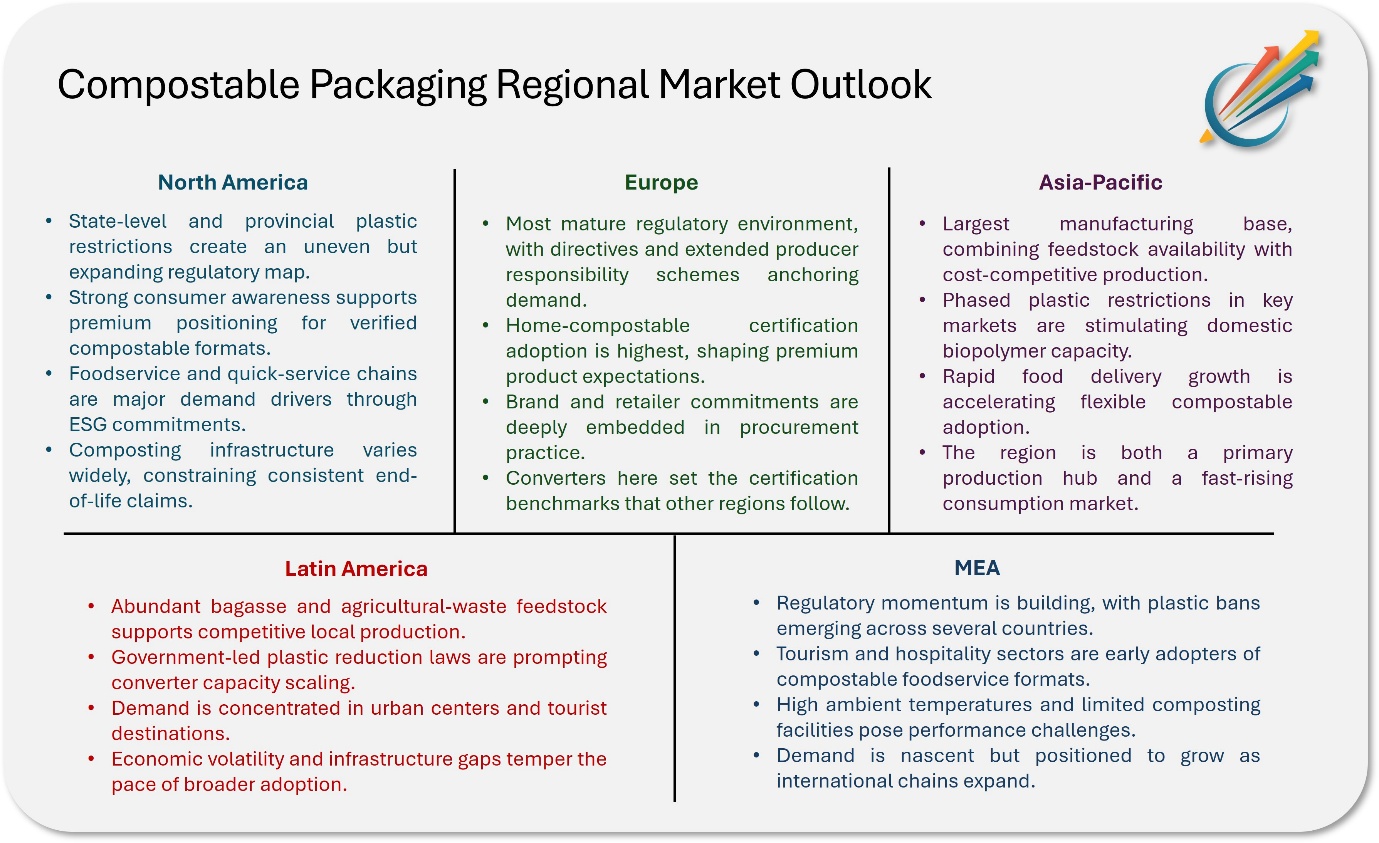
Regional Market Outlook
Investment Focus where the Lucrative Opportunity is Anticipated in Compostable Packaging Market
Certified Feedstock and Resin Supply
The most defensible positions in the compostable packaging market sit upstream. Control of certified PLA, PHA, and fiber feedstock determines who can deliver at contracted volume when demand tightens. Investors favoring this layer gain exposure to a structural chokepoint that finished converters cannot easily bypass.
Home-Compostable Material Innovation
Materials that degrade reliably outside industrial facilities command premium pricing and resolve the credibility gap that limits adoption. Capital directed toward PHA and advanced home-compostable formulations targets the segment where willingness to pay is highest and substitution objections are weakest.
Molded Fiber Production Capacity
Bagasse-based molded fiber combines structural performance, heat tolerance, and a comparatively stable raw material supply. Investment in scaled fiber production lines captures the fastest-shifting rigid foodservice demand, where regulation is most binding and conventional alternatives are being displaced outright.
Integrated Converter Platforms
Converters operating across flexible, rigid, and fiber formats with broad certification coverage are structurally advantaged in multi-category tenders. Backing integrated platforms rather than narrow specialists offers exposure to consolidation upside as conglomerates acquire scaled, certified capability.
What This Means for Decision-Makers
Brand Owners - Substitution is now a compliance and supply-availability question, not a sustainability debate. Securing certified converter capacity early protects against the qualified-supply scarcity that will define the next several procurement cycles.
Converters and Packaging Manufacturers - Feedstock control and certification breadth are the binding constraints on growth. Treating resin supply as a strategic asset rather than a procurement step is what separates structurally advantaged operators from exposed ones.
Investors - The thesis has matured past technology speculation. Upstream feedstock, home-compostable material science, and integrated certified platforms offer clearer risk-return profiles, with consolidation providing a credible additional return path.
Policymakers - Composting infrastructure, not material availability, is now the limiting factor on environmental outcomes. Coordinated investment in collection and processing capacity is what converts compostable adoption into measurable waste diversion.
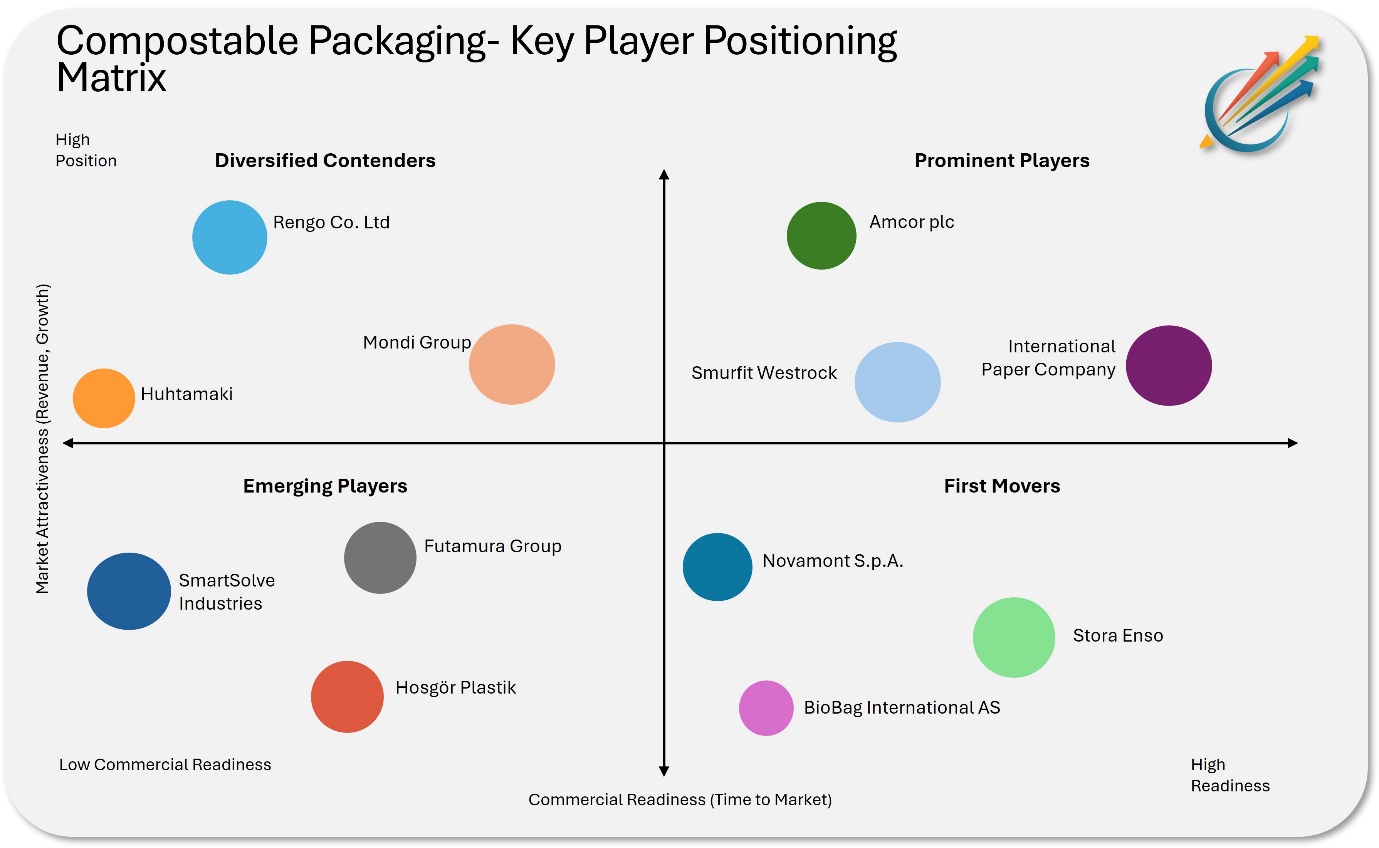
Competitive Landscape: Compostable Packaging Market
Recent Market Developments
- In March 2026, Amcor plc added a new production line in Italy to manufacture high-barrier films for food packaging applications.
- In February 2026, Tetra Pak International SA introduced improvements to its paper-based packaging designed for faster filling lines.
- In December 2025, Futamura Group showcased compostable film solutions at major industry packaging exhibitions ahead of the 2026 event season.
- In November 2025, Mondi Group continued scaling sustainable paper-based packaging production through expanded line capacity.
Get Access to complete Analysis, Buy Now: https://marketmindsadvisory.com/buy-now/?report_id=8
Trending Reports
- Pre Made Pouch Packaging Market
- Plastic Bottles Market
- PET Stretch Blow Molding Machines Market
- Paper Cups Market
- Paper and Paperboard Packaging Market
- Pallet Shippers Market
- Pallet Banding Machine Market
- Pallet Displays Market
- Packaging Suction Cups Market
- Packaging Tubes Market
Why choose Market Minds Advisory
Market Minds Advisory delivers decision-grade intelligence to executives across machinery, packaging, chemicals, automotive, ICT, food and beverage, consumer goods, and healthcare. We help organizations sharpen market expansion strategies, accelerate share gains, refine brand positioning, and enable account-level growth. Our forecasting integrates primary interviews, proprietary demand models, and continuous market validation, producing the kind of clarity volatile and emerging industries require. Backed by over a decade of sector expertise, our research surfaces white space, opportunity gaps, and competitive blind spots, accounting for recent developments and geopolitical risk. We help businesses see the future of their markets.
Contact Us
Market Minds Advisory
1521 Concord Pike, Suite 301
Wilmington, DE 19803
United States
Email: sales@marketmindsadvisory.com
Website: https://marketmindsadvisory.com/


Legal Disclaimer:
EIN Presswire provides this news content "as is" without warranty of any kind. We do not accept any responsibility or liability for the accuracy, content, images, videos, licenses, completeness, legality, or reliability of the information contained in this article. If you have any complaints or copyright issues related to this article, kindly contact the author above.
