

Achieve 1+1>2 Research Outcomes: A Combined Assay Workflow of Multiplex Bead-Based Assay Kits and ELISA
Broad High-Throughput Screening Followed by Rigorous ELISA Validation Improves Data Credibility While Consuming Precious Biological Samples
HUSTON, TX, UNITED STATES, October 13, 2026 /EINPresswire.com/ -- Researchers studying complex biological regulatory networks often face a common dilemma: choosing between multiplex bead-based assays and conventional ELISA for protein quantification. Rather than treating the two techniques as mutually-exclusive alternatives, scientists can deploy them as complementary tools. Cloud-Clone presents a synergistic experimental workflow: broad-scope high-throughput screening with multiplex bead-based kits followed by precise validation with ELISA kits. Powered by Cloud-Clone’s comprehensive portfolio of ELISA reagents and IS135 series multiplex bead kits, this combined approach conserves limited sample material, boosts laboratory efficiency and enhances data robustness, meeting stringent experimental standards expected by high-impact scientific journals.
In research areas including immuno-inflammation, tumour microenvironment, bile-acid metabolism, fibrosis and gut microbiota, readouts such as cytokines, chemokines, bile acids, fibrosis biomarkers and tumour-associated proteins form intricate regulatory networks. Measuring only a single analyte cannot fully interpret disease mechanisms. Investigators, pharmaceutical pharmacology researchers and laboratory teams frequently struggle when profiling dozens of candidate differential markers: should they run multiplex bead-based assays or traditional single-plex ELISA kits?
These two immunoassay technologies are not competitive substitutes. Instead, they constitute an advanced, complementary experimental strategy delivering 1+1>2 performance. This synergistic workflow enables broad-scale high-throughput biomarker screening together with definitive confirmation of key targets using the gold-standard ELISA platform. It balances experimental throughput and data stringency and satisfies rigorous evidence requirements for manuscripts submitted to Cell, Nature family journals and other top-tier publications. With nearly two decades of expertise in immunoassay reagent development, Cloud-Clone maintains fully-developed product lines for both ELISA quantification kits and multiplex bead-based detection kits. All core raw materials are developed in-house under unified quality-control standards, permitting joint testing using identical batches of clinical or animal specimens and delivering a complete reagent ecosystem for this efficient combined research workflow.
Inherent Limitations of Stand-alone Detection Platforms
ELISA: Gold-standard Single-Analyte Quantification with Constraints for Multi-marker Profiling
Enzyme-linked immunosorbent assay (ELISA) is globally recognised as the gold-standard technique for soluble-protein quantification and is the most widely-accepted single-marker validation method for peer reviewers. Cloud-Clone’s full collection of ELISA kits is built upon in-house-produced recombinant antigens and paired monoclonal antibodies, covering tens of thousands of analytes. The CES series kits detect metabolites, cytokines, fibrosis markers and tumour biomarkers, featuring three core strengths:
1.Exceptional specificity. Each well detects one target without cross-reactivity, delivering low background signals and a femtogram-per-millilitre limit-of-detection, enabling stable measurement of low-abundance proteins.
2.Standardised and accessible workflows. No specialised liquid-array instrument is required; standard microplate readers are sufficient, offering consistent assay reproducibility.
3.Wide linear dynamic range for quantification. Output data can be directly applied for statistical analysis, pharmacodynamic gradient assessment and stratification comparison of clinical specimens.
Nevertheless, ELISA has notable drawbacks for large-scale multi-target screening. Precious samples such as mouse serum, micro-biopsy tissue supernatants, human cerebrospinal fluid and diluted faecal extracts are available only in restricted volumes. Screening 10 or more cytokines by ELISA requires substantial sample partitioning, frequently exhausting specimens before replicate testing can be completed. Repeated liquid handling, incubation and wash-plate steps across separate microplates extend assay timelines to 5-7 days for a panel of 10 analytes. Cumulative manual operational variation and inter-plate bias may be introduced, consuming labour, consumables and biological material and making standalone ELISA unsuitable for exploratory broad biomarker screening.
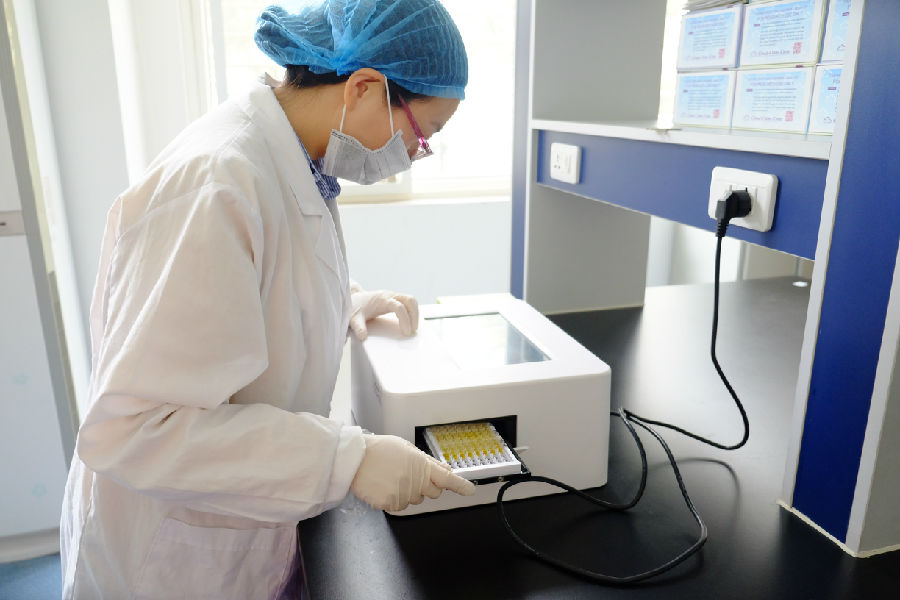
Figure 1. Laboratory technician operates a microplate reader for routine ELISA measurement.
Multiplex Bead-Based Assays: High-Throughput Workhorse for Exploratory Screening
Cloud-Clone in-house-developed multiplex bead-based kits leverage fluorescence-encoded bead liquid-array technology, overcoming the one-target-per-well restriction of conventional ELISA and serving as the preferred screening tool for multi-target network studies. Built from Cloud-Clone’s library of over 45 000 hybridoma clones for matched antibody pairs, these kits require only 25-50 μL sample volume per well and measure multiple analytes within one single run, accomplishing workloads that would otherwise demand dozens of individual ELISA microplates.
Multiplex bead-based assays deliver distinctive advantages for scarce-sample models including low-volume mouse tail-vein blood draws, cell-culture supernatants, human aqueous humour and foetal-derived specimens, large clinical cohort studies and broad-spectrum inflammatory-factor profiling. One experimental run rapidly identifies 3-5 statistically significant differentially-expressed core regulatory markers, narrowing the scope for downstream validation and preventing unguided ELISA pilot tests.
Still, multiplex bead-based assays are best deployed as a screening tool. The coexistence of multiple antibody pairs within one reaction well carries a minor risk of weak cross-reactivity among analytes sharing homologous sequences. In addition, per-analyte cost-efficiency is most pronounced when testing a relatively large marker panel.
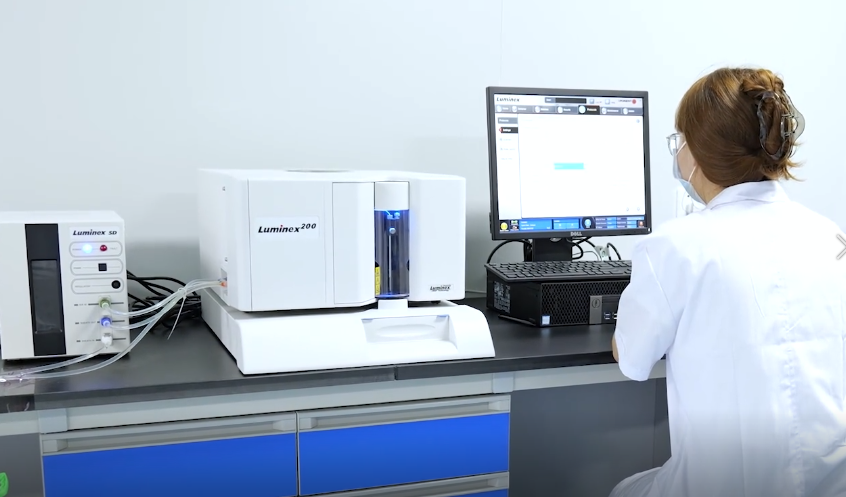
Figure 2. Researcher performs data acquisition using a Luminex instrument for multiplex assay kits detection.
The 1+1>2 Synergistic Workflow: Multiplex Screening Followed by ELISA Validation for Comprehensive Research Performance
Combining Cloud-Clone multiplex bead kits and ELISA kits establishes a standard workflow of “broad screening → target prioritisation → definitive confirmation”, bringing measurable improvements in technical reliability, sample conservation and overall cost-efficiency.
Technical complementarity for strengthened data robustness Both platforms rely on the sandwich immunoassay principle. Cloud-Clone uses identical in-house-sourced antigens and matched monoclonal-antibody pairs across the two product lines. Antibody affinity and epitope recognition are consistent, eliminating data divergence caused by mismatched reagent systems and enabling high comparability between results from the two assay types.
1.Cloud-Clone multiplex assay kits perform high-throughput profiling across complete signalling pathways. Researchers compare marker-level changes across control groups, disease-model groups and drug-dosage cohorts to pinpoint significantly up- or down-regulated core molecules and map biological regulatory networks.
2.Cloud-Clone single-plex ELISA kits are then deployed for the 3-5 prioritised functional targets. Independent microplate-based testing is performed in triplicate or more. Benefiting from zero cross-interference in single-target wells, ELISA delivers precise absolute-concentration measurements for mechanism interpretation, rescue-experiment readouts and in-vivo pharmacodynamic assessment.
Dual datasets generated by two orthogonal assay methodologies satisfy peer-review expectations for cross-technical validation and substantially reduce manuscript revision risks.
Maximised conservation of scarce biological specimens Limited sample volume represents a major bottleneck for animal and clinical investigations. Detecting 10 cytokines by standalone ELISA demands substantial sample aliquoting across ten separate plates. Under the synergistic workflow, a small sample aliquot is consumed for multiplex screening of all ten analytes. Only the 3 prioritised differential markers require further testing via ELISA using residual specimen material. Sample consumption can drop by more than 60 %, resolving common challenges linked to limited-volume mouse bleeds and precious clinical biopsy samples.
Optimised cost- and time-efficiency over full project cycles For panels containing merely 1-2 analytes, standalone Cloud-Clone ELISA provides more economical performance. When five or more markers need evaluation, however, the combined workflow excels on total cost and timeline. Measuring 8 markers exclusively with ELISA typically takes more than one week, with cumulative expenses for microplates, wash buffers and other consumables rising linearly. Using Cloud-Clone 8-plex bead kits completes screening within one working day. Subsequent ELISA validation is only performed for 2 differential targets of interest, compressing total experimental timelines down to approximately two days while lowering overall consumable expenditure. This solution cuts labour input and accelerates project progress for long-term cohort studies and multi-dose drug-efficacy assessments.
Standardised Step-by-Step Synergistic Workflow
Step 1: Broad-scope high-throughput screening with Cloud-Clone multiplex bead-based kits Collect serum, cell-culture supernatant or tissue homogenate specimens across control, disease-model and drug-intervention groups. After uniform sample dilution, load 25-50 μL per sample into pathway-customised multiplex bead kits (such as 8-plex inflammation panels, 5-plex fibrosis panels or 7-plex immune panels). Perform statistical analysis to identify significantly differentially-expressed biomarkers and define high-priority targets for downstream validation.
Step 2: Precise target validation using Cloud-Clone ELISA kits Select 1-3 markers showing prominent expression changes and strong biological relevance to your research pathway from screening outputs. Run Cloud-Clone target-specific ELISA kits on independent microplates with at least three biological replicates to generate robust single-analyte quantitative outputs for mechanistic illustrations, statistical analysis and key manuscript figures.
Step 3: Cross-reference datasets and refine scientific arguments for publications Compare expression-change trends obtained from multiplex bead-based and ELISA platforms. Highly concordant trends greatly reinforce experimental confidence. Where minor discrepancies are observed, discuss the results by referencing the intrinsic performance characteristics of each assay, adding depth to your manuscript discussion section.
End-to-end Reagent Advantages from Cloud-Clone to Support Combined Assay Strategies
Cloud-Clone is a reagent developer with full in-house development capacity for both ELISA and multiplex bead-based kits. This circumvents common pain points associated with mixing reagents procured from multiple vendors where antibody systems may be incompatible.
1.Matched antibody systems for consistent data outputs. ELISA and multiplex bead-based kits draw from Cloud-Clone’s internal repository of more than 18 000 unique antigens and 27 000 distinct antibodies. Identical monoclonal-antibody pairs are applied for each target analyte, minimising epitope-recognition discrepancies and delivering superior cross-assay data consistency compared with mixed-vendor combinations.
2.Comprehensive analyte coverage with flexible panel configuration. Cloud-Clone ELISA offerings span tens of thousands of analytes, including cytokines, bile acids, fibrosis-related proteins, hormones, tumour markers and metabolic small molecules. Pre-formulated multiplex bead panels are available, alongside fully customisable bead-kit configurations tailored for research projects ranging from digestive-disease immunology, tumour immunology and hepatic fibrosis, through to neuro-inflammation and reproductive-metabolism studies.
3.Rigorous unified quality-control standards guarantee lot-to-lot reproducibility. All products follow Cloud-Clone’s three-stage closed-loop quality-control protocols. Each production batch is validated with western blotting, immunohistochemistry and quantitative assay performance testing. Full validation images, instruction documentation and standard-curve reference datasets are provided, with complete product traceability accessible via the official website to meet archiving requirements for academic laboratories and pharmaceutical research facilities.
4.Comprehensive global technical support. When implementing combined multiplex-bead and ELISA experiments, Cloud-Clone technical specialists deliver end-to-end guidance covering multiplex instrument-running schemes, ELISA incubation optimisations, sample-dilution recommendations and statistical-analysis suggestions. Support enquiries receive responses within 24 hours to resolve practical challenges in joint-assay implementation.
As life-science research moves toward multi-pathway, multi-target and multi-layer mechanistic interpretation, single-platform immunoassays can no longer satisfy the strict rigour requirements of high-level research publications. Moving past the “either-or” mindset, researchers can adopt Cloud-Clone’s synergistic workflow combining multiplex bead-based broad screening and ELISA targeted validation to achieve optimal balances of throughput, sample conservation and data trustworthiness.
This well-established combined-assay paradigm has been widely adopted by global research teams, generating numerous publications in internationally renowned journals. By selecting Cloud-Clone’s fully in-house-developed reagent portfolio, researchers can source screening and validation tools from one single supplier. Reliable, cost-effective reagents accelerate project progression, supporting high-quality academic outputs and innovative drug-development programmes worldwide.
About Cloud-Clone Corp.
Cloud-Clone Corp. is dedicated to the development and production of high-quality immunoassay reagents and detection solutions. With a focus on antibody engineering, multiplex assay development, and cross-platform compatibility, the company provides research tools designed to support precision medicine and advanced biomedical investigation globally. Our core products and services include the research and development of proteins, antibodies, ELISA kits, primary cells, and multiplex cytokine assay kits, as well as professional CRO services to fully meet the diverse needs of biomedical research and related fields.
For more information about Cloud-Clone Corp, visit www.cloud-clone.com.
CLOUD-CLONE CORP.(CCC)
Tel: 001-832-538-0970, 0086-27-8425-9552
Email: mail@cloud-clone.com, sales@cloud-clone.us
Visit us on social media:
LinkedIn: https://www.linkedin.com/company/cloud-clone-corp/
Instagram: https://www.instagram.com/cloudclonecorp2023/
TickTok: https://www.tiktok.com/@cloudclonecorp2026
SuKi Duan
CLOUD-CLONE CORP.WUHAN
+86 133 4986 4062
Visit us on social media:
LinkedIn
Instagram
TikTok
X
Legal Disclaimer:
EIN Presswire provides this news content "as is" without warranty of any kind. We do not accept any responsibility or liability for the accuracy, content, images, videos, licenses, completeness, legality, or reliability of the information contained in this article. If you have any complaints or copyright issues related to this article, kindly contact the author above.
