
Dispersive Folded Metasurfaces for Visible Light Communications Beyond 1 Tbps
News originally published by
EIN Presswire
Concept and operating principle of DFMs.
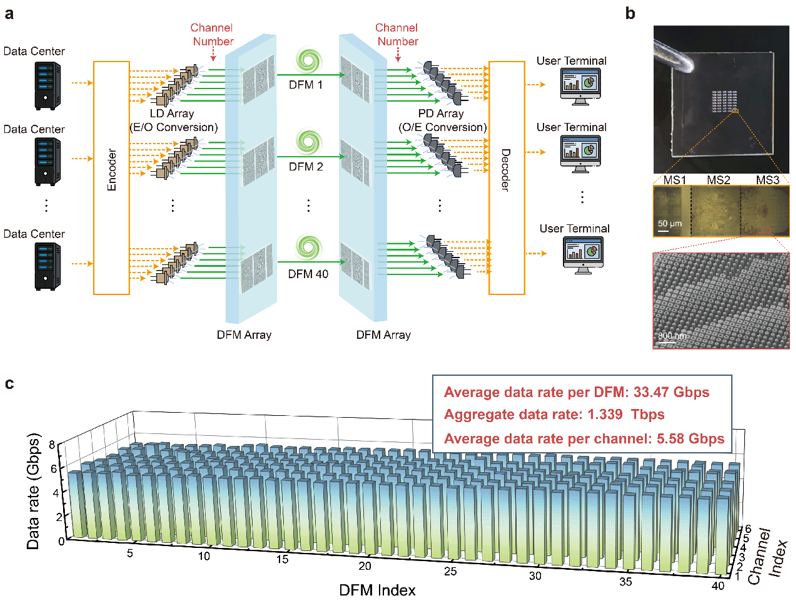
Scalable DFM array for high-density wavelength–OAM optical interconnects.
FAYETTEVILLE, GA, UNITED STATES, November 20, 2026 /EINPresswire.com/ -- Researchers in China have developed dispersive folded metasurfaces that combine wavelength and orbital angular momentum multiplexing. The devices use first-order angular dispersion to separate wavelengths along one axis while sorting OAM states along the orthogonal axis. A 40-device array within a compact 5×5 mm2 footprint supports an aggregate achievable rate of 1.339 Tbps, calculated from independently measured channel rates. The approach offers a route towards compact, high-density optical interconnects.
Visible light communication exploits abundant, unlicensed spectrum, but light-source bandwidth limits single-channel rates. Wavelength and orbital angular momentum (OAM) multiplexing can increase capacity, while separate functional subsystems complicate integration. Metasurfaces offer a compact platform, yet zeroth-order multilayer architectures require distinct phase responses at closely spaced wavelengths, imposing stringent dispersion and fabrication requirements. Integrating high-channel-count wavelength and OAM manipulation therefore remains challenging.
In a paper published in eLight, researchers from Harbin Institute of Technology, Shenzhen, Fudan University and Pengcheng Laboratory report a dispersive folded metasurface that integrates wavelength and orbital angular momentum multiplexing. An array of 40 devices, occupying less than 5×5 mm2, reaches an aggregate achievable rate of 1.339 Tbps when independently measured channel rates are added together. The work provides a compact and scalable framework for multidimensional optical communication and may stimulate further exploration of dispersion-enabled photonic systems.
A dispersive folded metasurface (DFM) integrates multiple metasurfaces along a folded optical path within a glass substrate. At the transmitter, it combines Gaussian input beams into coaxial wavelength–OAM channels; at the receiver, it separates these channels into distinct focal spots. The design uses diffraction dispersion as a functional resource, reducing the need for extreme local dispersion control. The researchers describe the underlying mechanism in their paper:
“The natural angular dispersion of the first diffraction order intrinsically separates discrete wavelengths along one axis, while the designed coordinate transformation independently sorts OAM states along the orthogonal axis.”
The researchers fabricated a five-metasurface device occupying only 0.22 mm2 and optically characterized 54 channels comprising six wavelengths and nine OAM states. The generated OAM beams exhibited an average mode purity of 91%. For high-speed communication, they developed a simplified three-metasurface design supporting two wavelengths and three OAM states, with the best-performing channel reaching 5.79 Gbps. They also demonstrated 4K video streaming. Extending this design to 40 devices produced 240 channels and a footprint-normalized capacity density of 53.56 Gbps/mm2, highlighting the potential for densely integrated optical interconnects.
The architecture could be relevant to short-reach applications, including chip-to-chip and board-level links. Its physical principles could also be extended to the telecommunications C and L bands, while polarization could provide an additional multiplexing dimension. Looking ahead, the researchers write: “We anticipate that the proposed DFM architecture will open a viable pathway toward compact, wafer-scale optical front-ends, which are essential for next-generation, high-capacity optical communication systems.”
References
DOI
10.1186/s43593-026-00146-9
Original Source URL
https://doi.org/10.1186/s43593-026-00146-9
Funding Information
This work was supported by Guangdong Provincial Cornerstone Program (Grant No. 2025B0303000008), AI for Science Program,Shanghai Municipal Commission of Economy and Informatization (2025-GZL-RGZN-BTBX-02036),National Key Research and Development Program of China (Grant Nos. 2024YFB2809200 and 2022YFA1404700), National Natural Science Foundation of China (Grant Nos. 62125501, 12334016, 62335005, 12625403, and 62505067), Integrated Project of NSFC Joint Fund for Regional Innovation and Development (no. U25A6014), New Cornerstone Science Foundation through XPLORER PRIZE,Shenzhen Fundamental Research Project (Grant Nos. JCYJ20241202123729038 and JCYJ20241202123719025), and Outstanding Scientific and Technological Innovation Talents Training Fund in Shenzhen.
Lucy Wang
BioDesign Research
email us here
Legal Disclaimer:
EIN Presswire provides this news content "as is" without warranty of any kind. We do not accept any responsibility or liability for the accuracy, content, images, videos, licenses, completeness, legality, or reliability of the information contained in this article. If you have any complaints or copyright issues related to this article, kindly contact the author above.
